We believe AMERICA’S FUTURE has a place in your classroom. With 179 works of poetry, fiction, essays, and visual language spanning 526 pages, it offers a rich mosaic of writers looking at what’s next for our nation through a literary lens. We have developed sample lesson plans suitable for AP-level high school classes and college-level work.
We offer a special discount to educators ordering copies of AMERICA’S FUTURE directly through WWPH DIRECT. Find the best pricing for AMERICA’S FUTURE here. An additional discount is available for copies of 20 or more.
For universities, we are now able to work through the Barnes & Noble College Bookstore program for your purchases.
Interested in having writers or editors from AMERICA’S FUTURE in your classroom? We can arrange it (at no cost to you with book purchase!)
Please email Caroline Bock at info @ washingtonwriters.org for details.
AMERICA'S FUTURE IN YOUR CLASSROOM - AN OVERVIEW
Teaching America’s Future
- Analyze contemporary poetry and prose responding to social, cultural, and environmental futures.
- Explore DMV regional voices in a national/global context.
- Develop close-reading, comparative analysis, and creative writing skills.
- Engage with themes of identity, migration, and technology
Themes/Topics to Explore:
America’s Future
Focus: What is “America’s future”—and who gets to imagine it?
Identity, Memory, and Inheritance
Focus: How does the past shape imagined futures? Generational stories.
Climate and Environment
Focus: Eco-poetics and climate futures
Technology, Surveillance, and Digital Lives
Focus: A.I., social media, disinformation, and digital futures
Justice, Activism & Collective Futures
Focus: Democracy, justice, and community building
Creative Futures Workshop
Focus: Students produce their own creative futures
EDUCATOR'S GUIDE - OVERVIEW -CLASSROOM OPPORTUNITIES and MATERIALS
We are thrilled that you are considering using AMERICA’S FUTURE in your classroom. If you are in the DC, Maryland, or Virginia area, we would be happy to discuss an in-person appearance by one of our writers in your classroom. If you are outside the DMV, we would be happy to arrange for a video visit with one of our writers. Please email editor Caroline Bock at info @ washingtonwriters.org to discuss.
- WWPH Direct Discount pricing (please note that this pricing can be adjusted depending on the book order). In addition, we are now working with Barnes & Noble College stores for distribution to colleges.
- Complete list of contributors
- Table of contents
- Select video samplings of poetry and prose featuring the writers of America’s Future
- Discussion/reading of America’s Future featuring Baltimore-area writers and the editors of AMERICA’S FUTURE (Caroline Bock and Jona Colson) at the iconic Enoch Pratt Free Library here.
- Discussion/reading of America’s Future on the Library of Congress ‘Poet and the Poem’ with editor Caroline Bock and Jona Colson and poet master GRACE CAVALIERI. PODCAST HERE.
- EDELWEISS REVIEW COPIES AVAILABLE HERE
- Thank you for reading and considering AMERICA’S FUTURE for your classroom!
-

Washington Writers’ Publishing House – AMERICA’S FUTURE
MARY ANN LARKIN- POETRY LESSON PLAN
POETRY
“Let Us Praise Sadness” by Mary Ann Larkin
designed by Professor Jona Colson for Montgomery College Humanities Day
Grade Level: 8–12 (adaptable)
Length: 45–60 minutes
Theme: Honoring Connections and Belonging Here and Beyond
Text: “Let Us Praise Sadness” by Mary Ann Larkin
Learning Objectives:
- Analyze how poets express complex emotions through metaphor and imagery.
- Discuss how writing can strengthen human connection and belonging.
- Compose a praise poem inspired by Larkin’s structure.
- Reflect on how emotion and creativity shape community and shared experience.
Materials:
– Poem: “Let Us Praise Sadness”
– VIDEO LINK TO POEM read by its poet Mary Ann Larkin
-Video link to more poets & writers from AMERICA’S FUTURE here
-Mary Ann Larkin Bio here and complete of contributors here
Activities
Warm-up: “Which emotion feels most powerful in your life right now? Why?”
Students may share verbally or write privately. (5 mins)
Before Reading the Poem: Introduction to Theme (3 minutes)
Briefly introduce the theme of belonging and emotion in writing.
Ask: “How can talking about difficult emotions bring people closer together?”
Reading the Poem: (5 minutes)
Read the poem aloud once or twice.
Ask students to listen for tone, emotion, and imagery.
Small-group Discussion: (10 minutes)
Questions:
– Why praise sadness?
– How does the bird metaphor shape the poem?
– What does “sing of sadness together” mean?
– How does acknowledging sadness build connection?
Prompt/Writing Workshop: Create a Praise Poem (15–20 minutes)
Students choose a difficult emotion and an animal.
Writing Scaffold (fill in the blanks):
Like a __________ (animal) filled with __________ (emotion/synonym),
A __________ on/in/above __________ (place),
Doing __________ (action)…
What does the animal teach about your emotion?
End with:
“Praise it, my ___________, and the __________ it comes from.”
Share your poem with the group!
SAMPLES from 2025 Montgomery College Humanities Day student poems here – published by the Washington Writers’ Publishing House’s online lit mag, WWPH WRITES.
AMERICA’S FUTURE IS AVAILABLE EVERYWHERE BOOKS ARE SOLD and can be bought via WWPH DIRECT at a special classroom use discount. Educator, please contact: Caroline Bock at info @ washingtonwriters.org
VARUN GAURI- POETRY LESSON PLAN
AMERICA’S FUTURE features work from 164 voices of poetry and prose. This landmark anthology meditates on the past and dares to imagine the future. This lesson plan discusses past and future generations…
POETRY
“The Generations” by Varun Gauri
Grade Level: High school AP classes and first-year college students
Length: 30-45 minutes
Text: “The Generations” by Varun Gauri
Pairs well with Three Generations of Black Women and a Look Into America’s Future by Bernardine Watson, a creative nonfiction essay also found in America’s Future. See video sample here. Lesson plan also provided.
Learning Objectives:
- Analyze how different characters within a poem can interact to suggest a specific theme/idea.
- Identify poetic techniques such as rhythm and tone, and how they can add to a piece’s themes or topics.
- Compose a poem that details an interaction between members of different generations in order to illustrate a greater idea (about societal or personal themes).
Materials
- Poem: “The Generations”
- Video: “The Generations” read by Varun Gauri; https://youtu.be/tLlwQwM4ccA
- Biography: Varun Gauri was born in India and raised in the American Midwest. He now teaches at Princeton University and lives with his family in Bethesda, Maryland. His short fiction was nominated for a Pushcart Prize and recognized in Best American Nonrequired Reading. His debut novel, For the Blessings of Jupiter and Venus (WWPH 2024), won the Carol Trawick Fiction Prize and was selected for NPR’s Books We Love 2024. More on Varun Gauri here.
Activities
Warm-up:
- “Think about interactions that you’ve had with people of other generations. Why do these interactions stand out in your memory? Did you learn something from them?” Students may discuss verbally or write privately. (5 minutes)
Before Reading the Poem:
- Briefly introduce rhythm and tone and how they can contribute to a poem. Contemplate some brief examples, such as by asking, “How can poets stress certain words in a poem?” or “How can rhythm force the reader to speed up or slow down when reading?” (3 minutes)
Reading the Poem:
- Listen as Gauri reads the piece, paying attention to how he pronounces the rhythm of the poem (where does he place stress when reading aloud?). Then, students will take turns reading, each student reading two lines. Try to emphasize the rhythm of the piece when reading aloud—it may be challenging when switching readers, but try to keep up with the rhythm. Underline or jot down lines that stand out to you. (5 minutes)
Small-group Discussion: (10 minutes)
- Questions:
- Where does Gauri create rhyme or use line breaks to stress certain words? What kind of rhythm does this create (Is it fast or slow? Is it punchy or lyrical?) Do you think this adds to the piece’s themes?
- Did the line where the professor throws his notes surprise you? What do you think this moment adds to the poem?
- Why do you think the poem is called “The Generations”? What kind of ideas does this suggest about the poem?
Ask for volunteers to share takeaways with the whole class.
Prompt:
- Write a poem that explores an interaction between members of different generations. (20 minutes)
- Create two (or more) characters that belong to at least two different generations. They can be made-up or inspired by your own experiences.
- Detail an interaction between the characters. What does the interaction reveal about greater societal or personal themes?
- Try creating a rhythm or rhyme to emphasize certain ideas.
ADAM SCHWARTZ - RHETORICAL WRITING LESSON PLAN
A Baltimore public school teacher uses satire to make his point in this epistolary essay. Nominated by the Washington Writers’ Publishing House for a Pushcart Prize.
PROSE
“Now That DEI Is Dead, Things Are Looking Up for Me” by Adam Schwartz
Grade Level: 11–12 AP English Language
Length: 40-45 minutes
Theme: Satire, Rhetoric, and Privilege
Learning Objectives:
Analyze the rhetorical strategies Schwartz uses to convey perspective
Evaluate how satire and exaggeration shape the audience’s perception of DEI, privilege, and meritocracy.
Practice writing analytically about tone, purpose, and audience using textual
Materials:
Text of Schwartz’s essay. Reading by the author of the complete essay can be found here.
Biography: Adam Schwartz’s debut collection of stories, The Rest of the World, won the Washington Writers’ Publishing House 2020 prize for fiction. His non-fiction has appeared in Newsweek, Baltimore Sun, Baltimore Banner, and elsewhere. He has taught high school in Baltimore for twenty-eight years.
Annotation tools / AP rhetorical analysis graphic organizer. Sample here
Warm-up (5 min):
- Prompt: “Identify a mythical character whose words or actions could spark debate about fairness or privilege. What makes their message persuasive—or satirical?”
Before Reading (5 min):
Briefly define satire, audience awareness, and rhetorical appeals (ethos, pathos, logos).
- Ask: “How might an author use humor or exaggeration to make a serious point about society?”
Reading the Text (10 min):
- Students annotate for rhetorical strategies, tone, audience cues, and evidence of ethos/pathos/logos.
Small-Group Discussion (10 min):
What is the author’s purpose in framing DEI as a “crushed” movement?
- How does the exaggerated praise for Trump affect the reader’s interpretation?
- Identify examples of irony, diction, and rhetorical How do these shape the argument?
- If you were to write a letter on a topic that matters to you, how would you frame it? Would you use satire like Schwartz? Or would you perhaps use sentimentalism? Would you use ethos and logos?
- Could you imagine writing a letter to a mythical character using satire, wit, and sarcasm to make a larger point?
AP-Style Writing Workshop (20 min):
Prompt (modeled on AP Rhetorical Analysis FRQ):
- “Analyze how Schwartz uses rhetorical strategies to convey his perspective on DEI and privilege. Consider tone, audience, and structure.”
- Students write a timed, structured opening paragraph that incorporates a satirical tone to a mythical character. For example: Dear Tooth Fairy… I believe the current rate for teeth is undervalued because prices are rising everywhere and…
Share & Wrap-Up (5–7 min):
Volunteers share thesis statements or topics plus the opening paragraph of Dear Mythical Character.
- Instructor highlights effective analysis of satire and rhetorical
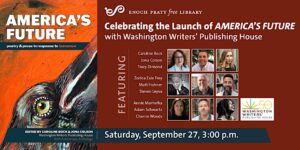
ADAM SCHWARTZ was part of a dynamic reading and discussion held at the Enoch Pratt Library, the main library in Baltimore, and a recording of that event can be found here.
BERNARDINE WATSON - CRITICAL ESSAY LESSON PLAN
A Black writer critically examines her life and her mother’s, and looks ahead to her granddaughter’s life and aspirations in science in this essay from America’s Future…
PROSE
“Three Generations of Black Women and a Look into America’s Future” by Bernardine Watson
Grade Level: 11–12 AP English Language
Length: 45 minutes
Theme: Historical Context and Rhetorical Structure
Learning Objectives:
- Analyze how Watson uses narrative, historical evidence, and generational perspective to convey her argument.
- Evaluate the interplay of ethos, pathos, and logos in a reflective nonfiction
- Develop analytical writing that connects the historical context to the author
Materials:
- Text of Watson’s essay
- Video sampling of the essay can be found in this video by Bernardine Watson
- Biography: Bernardine (Dine) Watson is a nonfiction writer and poet who lives in Washington, DC. Dine’s book Transplant: A Memoir, won the 2023 Washington Writers’ Publishing House prize for nonfiction. Transplant was also chosen by National Public Radio as one of the 2023 “books we love” and featured in Poets and Writers Magazine as one of its 5 over 50 debuts. Her poetry has also appeared in numerous journals. More at website here.
Activities:
Warm-up (5 min):
- Prompt: Think about a historical event that shaped the opportunities available to people today. Think of your grandparents, your parents, and you. What are the differences in opportunity for each generation? Can you narrow that opportunity to one area, such as education or employment? How are your opportunities different than your grandparents or great grandparents? How might a writer use personal narrative to illustrate the change in opportunity?
Reading the Text (10–15 min):
Students read and annotate for:
- Key historical references: Great Migration, Civil Rights, Brown Board of Education, Great Society.
- Ethos (credibility through personal/family history)
- Logos (historical facts and statistics)
- Pathos (emotional appeals through family stories)
Small-Group Discussion (10 min):
Questions:
- How does Watson build ethos through intergenerational narrative?
- What role does historical evidence play in shaping the argument?
- How does the author balance optimism for the future with acknowledgment of systemic barriers?
- Watson uses flashback for most of her piece to get her point If you were writing a piece about your childhood and you were to utilize a flashback, what would you include? Which parts of your childhood would it highlight? Would it focus in on one specific characteristic like Watson? Or would you explore many different aspects? Would it tell the tale of America at the time you were a child? How so?
AP-Style Writing Workshop (15 min):
Prompt (modeled on AP Synthesis or Rhetorical Analysis FRQ):
- Analyze how Watson uses rhetorical strategies to convey the challenges and opportunities faced by three generations of Black women. Use specific examples of ethos, pathos, and logos.
- Use Watson’s essay as a model for a three-generation essay of your own. Focus on your parents, your grandparents, and your future.
Share & Wrap-Up (5–7 min):
- Volunteers discuss thesis statements and/or an introductory paragraph
- Instructor highlights effective integration of historical context and rhetorical
DANA ELLYN - VISUAL ART INSPIRATION
 Visual Art
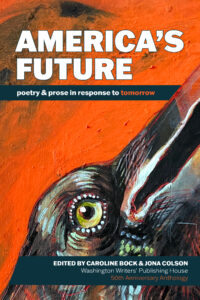
Capital Crow by Dana Ellyn
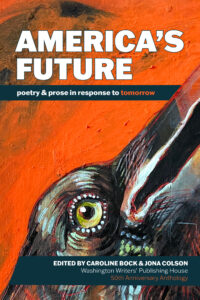
Capital Crow by Dana Ellyn, a strong, bold painting, aims to set the tone for the anthology. In Greek mythology, the crow is associated with Apollo, the god of music, poetry, healing, and prophecy. In Slavic, it’s associated with the afterlife, in the winter. The crow serves as a messenger in both mythologies, while also being a future-teller in Greek. Sitting in the center of the book cover, the crow stares at us intensely, a daunting and intimidating creature, bringing forth the message of the collection and daring you to read it. The bright orange-red is a vibrant, angry color, which supports the strength of the anthology. America’s future is daunting and uncertain, and the crow’s wide eye over the vibrant color encourages us to continue anyway. The bird is literally placed in front of America’s future, and if we are to explore what and who America is and will be, then we must dare to move past the bird and read its telling.
PDF of cover art: AMERICA’S FUTURE COVER – CAPITAL CROW BY DANA ELLYN
Dana Ellyn is a Washington, DC-based painter whose work often draws on literature, current events, and personal experience to tell complex visual stories. A DC resident since 1989, she’s been painting full-time from her downtown studio since 2002. Her paintings have been featured in galleries, museums, and private collections across the US and abroad. Known for her bold and layered imagery, Ellyn’s art invites viewers to read between the lines—much like a good book. She believes that it is the responsibility of contemporary painters to create meaningful work and respond, through their art, to the politics and policies that shape our world – not to simply regurgitate trends or create decorative art to be hung above couches.
Guiding questions for considering Capital Crow
- What kind of message do you think the crow is trying to give us?
- Dana Ellyn’s previous anthology cover for WWPH, This is What America Looks Like, uses an owl on its cover. Why do you think artist Dana Ellyn is choosing birds as the covers for the collections?
- How does the crow itself help with the message? Consider the color it sits in front of, the overlapping of colors, the shape of it all, etc.
- Do you think the message would be the same if the cover had a different animal? If it weren’t an animal at all?
Ekphrasis Writing Prompt
Look closely at the crow — If it could speak, what would it be saying right now about your future? About America’s future? Try to write in the “voice” of a crow (how would it sound? What diction or words would it use? Would it be still or in flight? Would it be alone or with others? What’s name would it have?). Write a short ‘persona’ poem with the crow as the speaker or a micro (250 words or less) from the Crow’s point of view.
DEBORAH TOMLIN - VISUAL ART INSPIRATION
 Visual Art
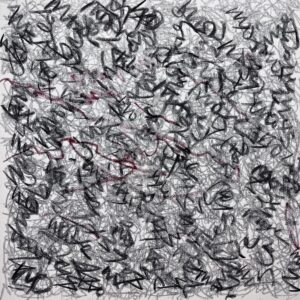
The Stupid Words People Say When You Have Cancer by Deborah Tomlin.
Charcoal and graphite on paper (2024).
Introducing all three parts in the anthology, Deborah Tomlin’s The Stupid Words People Say When You Have Cancer contains a multitude of imagery and meaning, which is reflective of the collection. Chaotic and scrawly, her drawings sit on the precipice of every section that holds the written works of our future, and that precipice increases in size with every section of the collection. The wording on the drawings is scrawly and blurry, which may symbolize the literal—the many phrases people pass along to Tomlin upon hearing her diagnosis—or the metaphorical, where the discord of her piece represents our unknown future. Do you feel uncomfortable looking at her pieces? Confused? Disquieted? Good. America’s future has untold and troubling paths for all of us, and her pieces are encouraging us to brace for it.
In Part I, stamped by the smallest version of her drawing, the written work that follows is U.S. representative Jamie Raskin’s Remarks as Delivered at the Hands Off! Rally on the National Mall, a passionate piece threatening our leaders to keep their hands off science. In Part II, it’s A Voice of Courage in a Time of Need by Marvin Kalb, rallying in us feelings of hope and determination about our calling, and Tomlin’s piece grows bigger. In Part III, it’s Raging Against the Sky by Jennifer Rodrigues, where we should be as enraged as the title suggests. Such emotions are conveyed by Tomlin’s drawing at its largest size, an intimidating grey and muddled black square. The Stupid Words help shape an arc within the collection, guiding readers to feel anything but satisfaction with our future when they finish it.
PDF of artwork: Stupid Words People Say When You Have Cancer by Deborah Tomlin
Deborah Tomlin, a Maryland native, is drawn to domestic life in her drawings and paintings. Common themes in her work include aging, loss, femininity, identity, and independence/dependence. In 2022, Tomlin was diagnosed with breast cancer. Treatment led her to incorporate text, often from her journal entries. Dress patterns, yarn, and embroidery thread figure prominently, referencing mending and darning. Tomlin uses these materials to transform her visceral scars into something beautiful.
Guiding questions for considering The Stupid Words People Say When You Have Cancer
- Why does Tomlin use charcoal as opposed to color like the other visual pieces? Consider brush stroke, shape, how you feel studying it, etc.
- How do the drawings in each Part connect with the written work that follows them?
Ekphrasis Writing Prompt
Look closely at the words—is there one that ‘jumps’ out at you? Write a short poem (haiku) or micro prose (100 words) inspired by that word. How does it relate to your future (or our nation’s)?
ZORINA EXIE FREY - VISUAL LANGUAGE AT ITS MOST CREATIVE
 Visual Language Essay
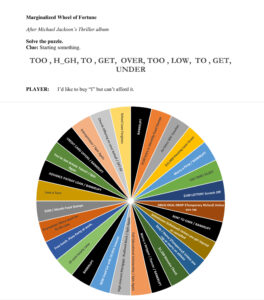
Marginalized Wheel of Fortune by Zorina Exie Frey
after Michael Jackson’s Thriller Album
It’s time to spin the Marginalized Wheel of Fortune! Go ahead and give it a spin—oh, you went bankrupt. Spin again? The wheel’s tic-tic-tic slows down and—darn, you went bankrupt again. You keep spinning until you run out of options. You try to answer the game’s puzzle once you finish and—man, you can’t afford it anymore. She hopes you are entertained enough to miss how much you are drastically falling behind in the game of life. Fry’s wheel of fortune is dark irony.
Spin the Marginalized Wheel is a satirical mirror of capitalist America. Fry is asking us all to look around: we are living in a system that has long bound us from sharing the wealth of our country. The missing I in the puzzle is us. Don’t believe Fry? Spin the wheel again. You might eventually learn that it’s not always about chance.
PDF of artwork: Marginalized_Wheel_of_Fortune by Zorina Frey
Zorina Exie Frey was part of our a special symposium centered on the America’s Future anthology held at The Enoch Pratt Library in Baltimore.

Zorina Exie Frey is an educator, content writer, and Pushcart Prize Winner. Her writings are featured in Shondaland, Glassworks Magazine, The Journal of Poetry for Therapy (Routledge Taylor & Francis, 2024), Introduction to Afrofuturism: A Mixtape in Black Literature & Arts (Routledge Taylor & Francis, 2024), and Chicken Soup for the Soul.
Guiding questions for considering The Marginalized Wheel of Fortune
- There is something to be said about the Marginalized Wheel and its connection to the American Dream. What is Fry telling us about it?
- One of the puzzle hints Fry leaves for us is “it’s after Michael Jackson’s Thriller album.” Following Thriller, Michael Jackson released his seventh album Bad. What kind of correlation is Fry making here?
- Can you find any potential loopholes in the wheel? Why or why not?
Writing Exercise
Create your own wheel, but in this case: The Future Wheel. Make this wheel a wish list. What are ten wishes for the future for you? Your family? America? In the future, I will be ___? My family will be ___? America will be ___? Now, add a list of thought-provoking prizes if you win under the wheel. How does the ‘look’ of this wheel make a statement about who you are? How is the world now? Your hopes and dreams?
NICOLE BAZEMORE - VISUAL LANGUAGE - FICTION
This Is Paradise by Nicole Bazemore
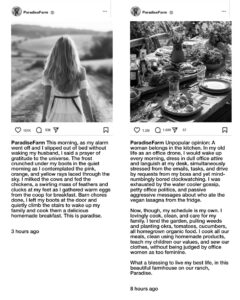
By 2013, Instagram and Facebook had gained so much notoriety that their social media platforms had over 100 million users worldwide. As its popularity grew, so did its shift from sharing about each other’s lives and connecting over common interests to being overshadowed by its highly politicized environment. Nicole Bazemore’s piece pries this shift open with Paradise Farm. In a series of Instagram posts, a woman endures a dystopian future where she slowly loses her freedom and autonomy. Bazemore is puncturing our faith in a just and safe future with a haunting and potentially real reality where women lose the battle over their autonomy. Social media is a black mirror of that future and of what happens when we’re passive in its creation. Her piece is a warning to us all.
PDF of artwork: This is Paradise by Nicole Bazemore
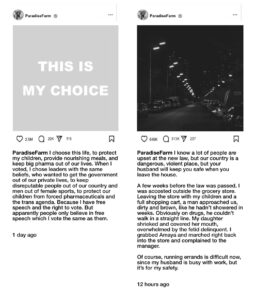
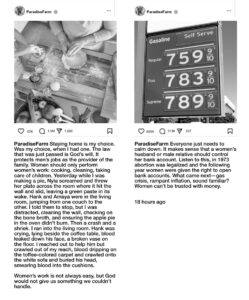
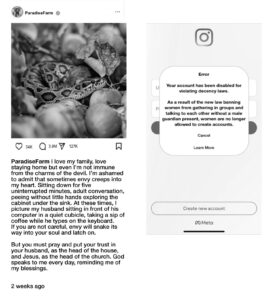
Nicole Bazemore currently resides in Vienna, Virginia, with her two royal feline overlords, nuclear-fusion-powered progeny, and life partner in crime.
Guiding questions for considering This is Paradise by Nicole Bazemore
- How does the language of the posts’ descriptions serve the visual piece as a whole? What does the comparison of her old office life to her settled-down life do in the first couple posts?
- What is Bazemore saying about the role of women in the near future?
- The woman’s seventh post describes her feeling “envious” of her husband and how she suppresses this feeling. How does this support the arc of the visual piece?
Ekphrasis Writing Exercise
Write a series of short social media posts to your future self. Ground the posts in a specific setting (place and time)? Now imagine that you are going on a journey. What advice do you want to send your future self? You can even start the piece: Dear Future self…
MARTHA ANNE TOLL - ESSAY WRITING WITH PHOTOGRAPHY
 “America’s Future in Dead Pianos?” by Martha Anne Toll
Martha Anne Toll’s art elevates her essay “America’s Future in Dead Pianos?” in a way that differs from that of the other writer-artists in the anthology. She does not want us to imagine what forced her to a stop on that street. Her raw photography forces the readers to see through her eyes the startling imagery of a dead instrument, which is so shocking to her it compels her to pause her stroll. Even in New York City, where one sees and hears just about everything, the piano’s predicament is enough to stop her. As we read along, we find out that it reminds her of the dead elephant cow she spotted on her safari trip and the piano-key sculpture she gave her husband as a birthday gift. There is a recognizable pattern in the memories: to reformat from broken pieces. The elephant cow’s soul is wrapped back up into the circle of life. The piano keys are used to make a new sculpture. Like the dead animal and instrument, America is a large, violent being founded on broken pieces. By asking us to imagine “a kinder future,” Toll predicts we can reformat the scattered remains of our country into something new and beautiful. Our future can be kind if we take control of it and make it so.
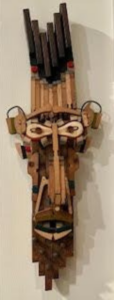
Read Martha Anne Toll’s prose with images here: America’s Future in Dead Pianos_ – Martha Anne Toll
Martha Anne Toll is a novelist and literary and cultural critic. Her second novel, Duet for One, was released in May 2025. Her debut novel, Three Muses, won the Petrichor Prize for Finely Crafted Fiction and was shortlisted for the Gotham Book Prize. Toll is a member of the National Book Critics Circle and serves on the Board of Directors of the PEN/Faulkner Foundation.
Guiding questions for considering America’s Future in Dead Pianos?
- Why does she include the poem she wrote about her safari trip on page 58? How does it serve her essay?
- Why else do you think she compares instruments to animals? How does this tie back to her prediction of America’s future?
Ekphrasis Writing Prompt
- Select any response you left for the ekphrastic writing questions on the other pieces. Give it another rewrite—is there one you’ve been wanting to change? How does the second draft alter your response to the question? Does it change how you view that visual piece?
- Have you ever encountered something or someone so memorable that it left you reflecting about it for the rest of your day? Was it so impactful that it altered the future you had in mind for yourself? Did it change how you viewed yourself? Write a micro piece (250 words or less) about that something or someone that left a piece of themself with you.
ELNATHAN STARNES - POETRY WITH VISUAL ART
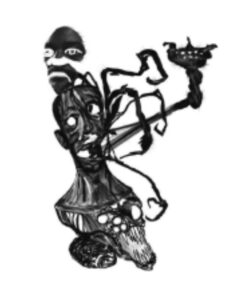 Sculpture and Drawing
“Disorder” and “SOMA Fallout” by Elnathan Starnes
“Disorder”
Elnathan Starnes’s piece Disorder draws on the destruction of peace and tranquility. Accompanying his poem is a drawing of an individual demonstrating the rupture of order. Its “face” has been separated from its withering body, a creature breaking from its chest, spindly appendages protruding from its mouth, and another amorphous appendage stretching from the person’s neck.
The drawing follows the arc of the poem. As each line rearranges itself, so does the individual. Its twisted limbs and form are “dissing” on “order” or perhaps dissing on our maintenance of it. Perhaps there is something to be said about this person’s inability to consume the disorder now vomiting out of his mouth. Starnes is telling us this is what we will become if we allow discord to fester.
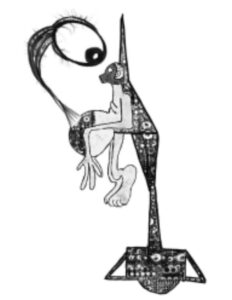
“SOMA Fallout”
Starnes creates another visual piece that centers on aspects of the body and consumption. Soma in Greek means “body.” The piece warns us about the destruction of our bodies, though this time the destruction doesn’t come from disorder but from overconsumption. The figure has a bloated belly, and an eye protrudes from the stomach. The eyes watch what this person takes in and are the only physical supports for the figure, almost as if they’re suspending him in the air and trapping him. The figure then hides behind a mask, perhaps in “denial of an After-the-end-of-the-world-reality,” and ignores the surveillance on them.
Read poems with art pieces here: Disorder and SOMA Fallout
Elnathan Starnes has participated in various poetry readings in the DMV for decades. His first published poem, “Items in a Neighborhood,” is featured in The Great World of Days (2021). Elnathan self-published his first children’s book, Put Your Seat Belt On, and is currently working on his poetry comic book. Elnathan has his own children’s entertainment and teaching artist business under the moniker Groovy Nate.
Guiding questions for considering “Disorder” and “SOMA Fallout.”
- Disorder and SOMA Fallout both focus on the disfiguration of bodily autonomy. How do they differ from each other?
- How are the poems enhanced by their drawings? How do they match with their drawings?
- What else is Starnes trying to say about the future of our autonomy?
Ekphrasis Writing Prompt
In traditional story structure, the world is in stasis until a trigger disrupts the normalcy and causes discord. Once the story begins, our character goes on a journey where they can’t return to the world as it was, or they return as a different person. Write a micro piece (in 500 words or less) about an event or memory in your life where the normal, the stasis, was disrupted by a trigger, and it changed your life.